
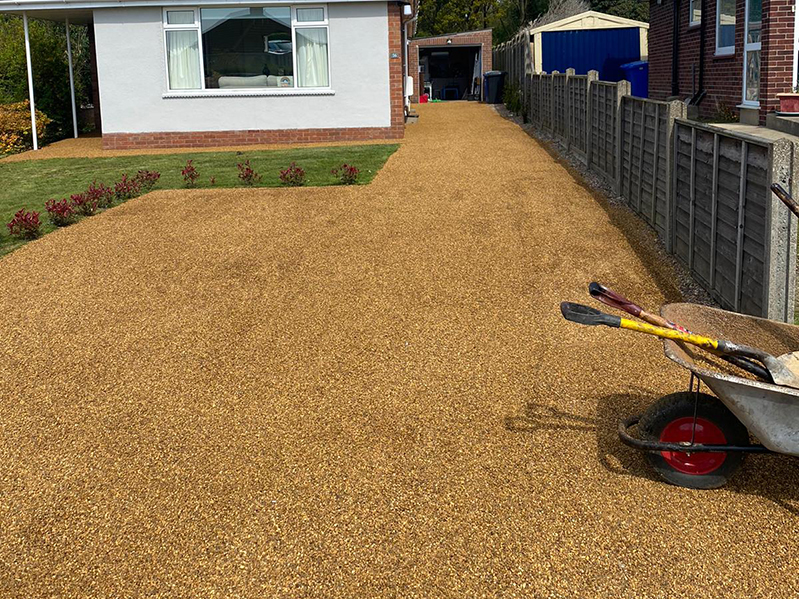
If you’re thinking about a new driveway and you keep coming across the term “tar and chip” you’re in good company. It’s one of the most popular surfacing choices in the UK, and for good reason. It’s hard-wearing, attractive, surprisingly affordable, and suits everything from a modest residential driveway to a long rural track.
In this guide, we’ll walk you through everything you need to know about tar and chip driveways: what they are, how they’re installed, how much they cost, and whether it’s the right choice for your home.
What is a Tar and Chip Driveway?
What is a Tar and Chip Driveway?
A tar and chip driveway — also known as tar and stone, chip and seal, tar bond, or macadam — is created by applying hot liquid bitumen to a prepared surface and then pressing stone aggregate firmly into it with a heavy roller. The result is a textured, natural-looking surface where the stones are permanently embedded into the bitumen base.
It’s been used on roads and driveways across the UK for well over a century, and it remains a firm favourite thanks to its combination of durability, low maintenance, and aesthetic appeal.
Tar and chip is often confused with loose gravel or tarmac, but it’s distinct from both. Unlike gravel, the stones are bonded into the surface — they won’t scatter across the lawn or get kicked onto the pavement. And unlike plain tarmac, the aggregate gives it a natural, textured appearance with a choice of colours and stone types.
How is a Tar and Chip Driveway Installed?
How is a Tar and Chip Driveway Installed?
The installation process is one of the things that makes tar and chip such a reliable surface. When done properly, with good groundwork at the base, you get a result that will stand up to years of daily use with very little attention needed.
Here’s how it works:
1. Preparation and groundworks: Every good driveway starts with a solid foundation. The existing surface is cleared and any potholes or weak spots are addressed. For a brand new installation, we excavate the site and install a compacted sub-base of mixed aggregate — this is what gives the finished driveway its strength and stability.
2. Laying over an existing driveway: If your existing driveway surface is in reasonable condition, it may be possible to apply the new tar and chip surface directly on top, saving on excavation costs. In this case, the surface is thoroughly cleaned and any significant damage repaired before work begins.
3. Applying the bitumen: Hot K-170 polymer-reinforced bitumen is applied to the prepared surface. This acts as a strong, sticky base layer that bonds everything together.
4. Spreading and compacting the aggregate: Your chosen stone aggregate is spread evenly across the bitumen while it’s still hot, then compacted firmly into place using a heavy roller. This embeds the stones securely and creates the characteristic textured surface.
5. Finishing: The surface is checked, any edges are neatened up, and the driveway is left to set. You’ll typically be able to use it within a day or two, though we’ll always advise you on the specifics for your installation.
At Driveline Surfacing, all our tar and chip installations come with a 5-year guarantee as standard – because we’re confident in the quality of our work and the materials we use.
How Much Does a Tar and Chip Driveway Cost?
How Much Does a Tar and Chip Driveway Cost?
One of the biggest selling points of tar and chip is how good it looks — and the amount of choice you have in terms of finish.
The aggregate you choose has the biggest impact on the overall appearance. At Driveline Surfacing, we work with two particularly popular options:
• Grey granite — angular pieces of crushed granite with clean, flat, reflective faces. This gives a smart, contemporary look that suits modern and traditional properties alike.
• Pea shingle — small, rounded, naturally smooth stones in warm shades of light brown. This creates a more natural, rustic feel that works beautifully for rural properties, farmhouses, and cottages.
Other aggregate colours and types are available, so if you have something specific in mind, it’s always worth asking. The right choice will depend on your property style, your personal taste, and what finishes are available in your area.
How Much Does a Tar and Chip Driveway Cost?
How Much Does a Tar and Chip Driveway Cost?
Cost is one of the most common questions we get asked, and it’s understandable — a new driveway is an investment, and you want to know roughly what you’re looking at before picking up the phone.
As a general guide, tar and chip driveways typically cost in the region of £45–£75 per square metre for a professionally installed surface. This makes it one of the more affordable hard driveway surfaces available, sitting below block paving and resin bound in terms of upfront cost.
The main factors that influence the final price are:
- Size of the driveway — larger areas cost more in total, but the per-square-metre rate can be lower
- Groundworks required — if significant excavation or sub-base work is needed, this adds to the cost
- Existing surface condition — resurfacing over a sound existing base is generally cheaper than a full new installation
- Aggregate type — some stones are more expensive than others
- Access and location — difficult access or remote locations may affect the price
The best way to get an accurate figure is to have someone take a look in person. We offer free, no-obligation quotes across all our service areas, so there’s no cost to finding out exactly what your project would involve.
How Long Does a Tar and Chip Driveway Last?
How Long Does a Tar and Chip Driveway Last?
With a good installation and a well-prepared sub-base, a tar and chip driveway will typically last 15–25 years. The lifespan depends largely on the quality of the groundwork beneath it — which is why we place as much emphasis on what happens below the surface as on what you can see above it.
In practice, a tar and chip surface holds up very well to everyday use. It doesn’t develop the same cracks and potholes that you sometimes see with cheaper tarmac installations, and the textured surface means it wears evenly over time.
That said, it’s worth being aware that in the first few weeks after installation, a small number of surface stones may work loose. This is entirely normal and nothing to worry about — the vast majority of stones are firmly embedded from day one, and the surface settles quickly.
What Maintenance Does a Tar and Chip Driveway Need?
What Maintenance Does a Tar and Chip Driveway Need?
Very little — which is one of its most appealing qualities.
Once the surface has fully cured, it needs no sealing, no resanding, and no specialist products. An occasional sweep to remove leaves and debris is all that’s typically required. Unlike block paving, there are no joints for weeds to colonise; unlike gravel, there’s nothing to rake back into place.
If any small repairs are needed further down the line — for example, if a localised area of surface stone becomes loose — these can usually be carried out quickly and at minimal cost without disturbing the rest of the driveway.
Is a Tar and Chip Driveway Suitable for My Property?
Is a Tar and Chip Driveway Suitable for My Property?
Tar and chip works well in a wide range of situations. It’s a particularly good choice if:
- You want a natural, textured look — the stone aggregate gives a more characterful finish than plain tarmac
- Your driveway is on a slope — the naturally anti-slip surface provides excellent grip in wet and icy conditions, which plain tarmac can’t always match
- You have a larger or longer driveway — tar and chip is cost-effective at scale, making it popular for longer driveways, farm tracks, and rural properties
- You want low ongoing maintenance — there’s very little to do once it’s installed
- You’re on a budget — it delivers an attractive, hardwearing surface at a more accessible price than premium options like resin bound or block paving
It can also be used for commercial driveways, car parks, and agricultural tracks — not just residential use.
Tar and Chip vs. Tarmac – What’s the Difference?
Tar and Chip vs. Tarmac – What’s the Difference?
This is a question we get asked often. Both surfaces use bitumen as a base, but there are some important differences:
|
Tar & Chip |
Tarmac |
|
|
Appearance |
Natural, textured stone finish |
Smooth, black surface |
|
Anti-slip |
Excellent — stones provide grip |
Moderate — can be slippery when wet |
|
Cost |
Similar — £45–£75/m² |
Similar — £50–£80/m² |
|
Maintenance |
Very low |
Low — may need sealing/patching |
|
Lifespan |
15–25 years |
15–25 years |
|
Customisation |
Choice of aggregate colour |
Limited (usually black or dark grey) |
For most homeowners who want a practical, good-looking surface at a reasonable price, tar and chip offers slightly more in terms of appearance and grip — without costing significantly more than tarmac.
Does a Tar and Chip Driveway Need Planning Permission?
Does a Tar and Chip Driveway Need Planning Permission?
In most cases, no — replacing or installing a driveway in front of your house falls under permitted development in England, and doesn’t require planning permission provided certain conditions are met.
However, because tar and chip is an impermeable surface (water doesn’t pass through the bitumen layer), you will need to ensure adequate drainage is in place. Post-2008 building regulations require all new impermeable driveways to manage surface water appropriately — but this doesn’t have to mean connecting to a public drain. If water can run off naturally onto a lawn, garden, or into a soakaway, that’s typically sufficient.
We handle drainage as part of our installation process and will always ensure your new driveway is compliant. If you have any concerns about planning or drainage, just ask — we’re happy to advise.
Frequently Asked Questions About Tar and Chip Driveways
Frequently Asked Questions About Tar and Chip Driveways
How soon can I use my driveway after installation?
You can usually walk on the surface within a few hours, and drive on it within 24–48 hours. We’ll confirm the specific guidance for your installation on the day.
Will stones come loose after installation?
A small amount of loose stone in the first few weeks is normal and expected. The vast majority of the aggregate is firmly embedded from the outset, and once the surface has fully cured this stops entirely.
Can tar and chip be laid in cold or wet weather?
Light rain isn’t a problem, but we won’t install in heavy rain or where there’s standing water, as this affects the bitumen’s ability to bond properly. Cold temperatures can also affect the process, so we plan installations around the weather.
Can I have a tar and chip surface on a steep driveway?
Yes – in fact, it’s one of the better choices for sloped driveways. The aggregate surface provides excellent grip underfoot and under tyre in wet or frosty conditions.
Is tar and chip suitable for heavy vehicles?
Yes. With a properly prepared sub-base, tar and chip handles cars, vans, and light commercial vehicles without issue. For very heavy vehicles used regularly, it’s worth discussing sub-base specification when we visit.
How does tar and chip compare to resin bound?
Resin bound offers a smoother, more premium finish and is fully permeable (no drainage concerns). It typically costs more upfront but has a similar or longer lifespan. Tar and chip is the better choice if budget is a priority or if you prefer a more natural, textured look.
Get a Free Quote for Your Tar and Chip Driveway
Get a Free Quote for Your Tar and Chip Driveway
If you’re in Norfolk, Suffolk, Cambridgeshire, Lincolnshire, or Essex and you’re thinking about a new tar and chip driveway, we’d love to come and take a look.
At Driveline Surfacing, we’ve been laying tar and chip surfaces for homeowners and businesses across East Anglia for years. We know how to get it right, from the groundwork up, and we back every installation with our standard 5-year guarantee.
Request a free, no-obligation quote or call us on 01603 856966 and we’ll arrange a convenient time to visit.
Areas Covered
Latest Posts
How Long Do Resin Driveways Last? Factors That Affect Their Longevity
When considering a new driveway, resin-bound surfaces' durability and aesthetic appeal are often enticing. [...]
The Ultimate Guide to Resin Bound
Resin-bound surfaces have become a very popular choice for driveways, patios, pathways and other open [...]

The Ultimate Guide to Tar & Chip
Tar and chip is becoming an increasingly popular surface option in the UK thanks [...]